An adventurous and scenic trek through the Valley of Glaciers in the Langtang Valley Trek.
Participate in one of the most adventurous, scenic, and thrilling drives from
Immerse yourself in the Sherpa and Tamang culture and Buddhist religion in the Langtang region.
Trek through mesmerizing rhododendron, pine, maple, and oak forests in the Langtang National Park area.
Explore the historical Yak Cheese Factory and get a unique taste of cheese and other local delicacies in the Langtang region.
Magnificent views of snow-capped mountains like Ganesh Himal Langtang Ri, Langtang Ri, Langsisa, and Ganjala Peaks.
Get a blessing by visiting the ancient Kyangjin Gompa, the ancient Buddhist monastery sitting right between the mighty Himalayas.
A chance to go for a day hike to the Tserko Ri (4,985 meters), a perfect viewpoint to witness a 360-degree view of the Himalayas and the settlements.
Langtang Valley Trek is a famous and highly preferred Trekking Route in Nepal. This trekking route shows a side of the Himalayas with an affordable Cost & Itinerary for 2025/26 from the Trekking agency. Situated to the north of Kathmandu, this hike provides an unusual combination of remote beauty, cultural diversity, and unspoiled nature. With each step, the trekkers immerse themselves in pristine landscapes and genuine traditions. With all these experiences, the Langtang Valley Trek feels like a hidden gem instead of just a packed trekking trail.
The Langtang Valley Trekking trail takes you through lush rhododendron forests, alpine meadows, and glacial valleys. Along the way, you will also see charming, time-frozen towns, old monasteries, and spectacular waterfalls. Moreover, the jewel in the crown is a serene valley, referred to as the "Valley of Glaciers," from which towering peaks like Langtang Lirung can be seen. Besides, the Langtang Valley Trek is a walk in the real-life version of a fairy tale set in the Himalayas.
So, the Langtang Valley Trek begins with a scenic drive from Kathmandu to Syabrubesi, followed by days of hiking through diverse terrains. You’ll ascend through forests, cross roaring rivers, and reach Kyanjin Gompa. In addition, tea houses offer warm hospitality, and every turn reveals breathtaking views. The journey is challenging yet rewarding, leaving you eager to discover more.
Also, did you know that Langtang is a cultural treasure trove? Significant as the home to Tamang and Sherpa communities, their Buddhist traditions and warm hospitality captivate. Prayer flags flutter, prayer wheels spin, and festivals like Losar bring the valley alive with music and rituals. The ancient Kyanjin Gompa adds a spiritual dimension, offering a glimpse into deep-rooted faith.
In summary, the Langtang Valley Trek blends adventure, culture, and natural beauty. It’s a journey off the beaten path, offering a unique perspective of Nepal’s Himalayas. From glacial valleys to vibrant traditions, this trek promises an unforgettable experience for those seeking something truly special.
We provide an experience you won't soon forget at Nepal Unique Treks. We have been leading trekkers from all over the world for more than 20 years, guaranteeing smooth and trouble-free travel. Furthermore, as a government-approved trekking company, we provide safety, comfort, and first-rate service to make your Himalayan adventure genuinely unforgettable.
Our team of experienced guides has been navigating the challenging Himalayan terrain for over ten years and is government-certified. Moreover, they are highly knowledgeable about high-altitude treks, the local way of life, and the landscape. They also ensure that you stay informed, safe, and fully engaged in the experience. In addition, our guides are available to help you at every stage, whether you're facing challenging climbs, acclimating to higher elevations, or learning about local customs.
We create itineraries tailored to your needs, recognizing that every trekker has a unique pace and preference. We can customize a journey to fit your timetable, add extra days for acclimatization, or let you discover undiscovered treasures along the way. Our itineraries are carefully crafted to provide the perfect balance of adventure, safety, and cultural exposure.
Nepal Unique Treks handles every aspect of logistics, from obtaining permissions to setting up the greatest lodging and food options. To guarantee your comfort and provide you with friendly hospitality in the heart of the Himalayas, we also carefully choose tea houses and lodges. Our solid local ties also provide an additional degree of ease, enhancing the immersion and smoothness of your journey.
Before setting foot on this stunning trail, trekkers must secure the necessary permits to ensure a smooth journey. These permits not only help preserve the region’s natural beauty and cultural heritage but also support sustainable tourism efforts. Furthermore, carrying the correct permits is essential to avoid fines or penalties during the trek. Therefore, obtaining the necessary permits is mandatory to trek in Langtang Valley.
The first required permit is the Langtang National Park Entry Permit, which allows access to the protected area of Langtang National Park. Trekkers can obtain this permit from the Nepal Tourism Board office in Kathmandu or at the park entry point in Dhunche.
Similarly, the second required permit is the TIMS Card (Trekkers' Information Management System), which is essential for tracking and managing trekkers’ safety. It can be obtained from the Nepal Tourism Board office in Kathmandu or the Trekking Agencies’ Association of Nepal (TAAN) Office.
These permits are not only crucial for entering Langtang National Park but also for accessing local communities and ensuring a safe trekking experience. Moreover, checkpoints along the route will verify these documents, so trekkers must carry them at all times.
The Langtang trek takes adventurers through challenging high-altitude terrain. During this ascent, we will pass through several remote villages, lush forests, rural areas, and many ups and downs. Walking in such remote and difficult terrains can invite many obstacles and uncertain situations as well. So, what helps trekkers in such situations? Not to mention, it's nothing other than travel insurance.
Here are some of the major reasons we strongly recommend that trekkers strongly obtain travel insurance for the Langtang Valley Trek:
First and foremost, medical facilities are limited in these remote areas. Consequently, insurance covering emergency evacuation, medical expenses, and trip cancellations is vital for a safer experience.
Besides, emergency evacuation coverage is critical during the Langtang Valley Trek. Why so? Well, during this trail, trekkers might suffer from acute mountain sickness, severe injuries, or other medical emergencies. Due to this reason, they may subsequently require helicopter evacuation to Kathmandu as well. Without a doubt, such evacuations can be extremely costly. If you obtain travel insurance, it will cover the expenses you incur for emergency evacuation.
Trekking in the Himalayas involves risks such as hypothermia, dehydration, food poisoning, and accidents on treacherous trails. This makes medical coverage imperative. Travel insurance can cover all the medical expenses you incur in such a situation.
Moreover, travel insurance safeguards against trip cancellations, delays, or lost luggage. The Langtang trek demands extensive planning. Due to that reason, unexpected circumstances like flight cancellations, natural disasters, or personal emergencies are pretty common. Hence, a suitable travel insurance policy can reimburse non-refundable expenses and help manage unforeseen situations.
In conclusion, we do not say that travel insurance is mandatory. However, obtaining travel insurance can help trekkers in a lot of circumstances.
Welcome to Nepal! As you arrive at the Tribhuwan International Airport, you will meet our representatives who will drive you to the hotel. In the hotel, the staff welcome you with a refreshing welcome drink before you settle into your room. For the rest of the day, we recommend you stroll around the city area, try out some local food, and go for a much-needed massage at the therapy and spa places.
In the evening, we invite you for a welcome dinner in the hotel. Delve deep into the taste of local cuisines (Khana set) and get insights about the trekking route from the professional guides before going for a cozy and comfortable sleep.
It's the second day and also the start of the journey towards the Langtang Valley. As you wake up in the morning and have your breakfast, our local representatives will drive you to the bus station. From there, we will go for a scenic and adventurous drive towards Syabrubesi, the starting or the entry gate to the Langtang Valley Trek. It takes about 7 to 8 hours for the drive to cover a total distance of 122 kilometers.
In between this drive, we passed through several villages, towns, settlements, forests, waterfalls, and streams. Moreover, the route also transitions from black-pitched roads to more rugged and off-road sections. As you reach Syabrubesi, you will start feeling the Himalayan breeze encouraging you to ascend higher and higher calmly. In the evening, you will go for the first dinner in the Langtang region. After that, it's go-to-sleep time.
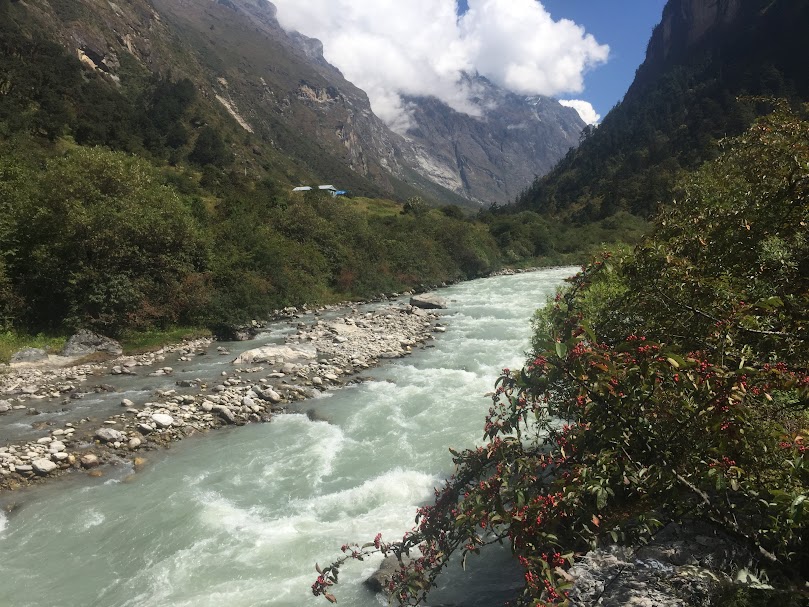
From the third day, it's the actual start of one of the most thrilling and adventurous journeys in the Langtang region. As you start the walk, you will feel like travelling in a dreamland. Just imagine walking by the Langtang River's edge, navigating through emerald forests and lush rhododendron blossoms, while the cool mountain breeze reminds you of where you are. Covering a total distance of 11.3 kilometers takes about 6 hours.
Each step in this section of the Langtang Valley Trek feels like walking deep into the lap of the Himalayas. Slowly and gradually, you start getting sneak peeks into the mighty Himalayas while walking over some suspension bridges. As we keep ascending, the trail takes us past two major villages of the Langtang Valley Trekking map, Bamboo and Rimche. After that comes a hotel sitting at an altitude of 2,380 meters above sea level, the Lama Hotel. That's where we will have dinner and sleep for the third day.
Aren't you excited to visit Langtang village? Heard any tales about this village? Well, why worry? Today, we will take you to the village itself. After you have your breakfast in the Lama Hotel, the Sherpa guides lead you on a steadily ascending trail through a mystical alpine forest where the morning mist clings to moss-covered trees. This section of the Langtang Valley Trek is also accompanied by the roar of the Langtang River that flows below your feet.
Keep walking, and we will also pass through another settlement named Ghodatabela, and that is where the landscapes shift. You can sense the dense woodlands transitioning into vast meadows and alpine terrains. As you approach Langtang Village, fluttering prayer flags cover the trail that we walk on. Within a short time, we will enter the most awaited Langtang Village, a village where tradition and culture open up a heaven-like settlement. The traditional stone-built houses with roofs framing endless Himalayan sightings make you forget the strenuous journey. Stroll around the village for a while before having dinner and a cozy alpine sleep.
From this day onwards, we recommend the trekkers take care of altitude sickness. As we will be ascending to an altitude of 3800 meters above sea level on the fifth day, the changes are as high as the altitude itself. Not to worry, because our Sherpa guides will also take proper care of you throughout the 10-day Langtang Valley Trek. As usual, we start the walk early in the morning after you have had your breakfast. After that, a walk through an alpine trail, over some glacial moraines, and the best of those, a spiritual experience up until the Kyanjin Gompa.
As you step into the Kyanjin Gompa's boundary, you will sense a different peacefulness and calmness. Just entering this village feels like a meditation for the soul and your mind. Named after the ancient monastery, this village stands as one of the significant beacons of Tibetan heritage. Other than the religious calmness, the village also offers trekkers breathtaking views of sky-towering Himalayas. In our spare time, we recommend the trekkers to visit the nearby traditional cheese factories. Also, interact with the locals while feeling the cool glacial breeze.
On the sixth day, the trekkers will reach the highest point of the entire Langtang Valley Trekking map. Yes, it's certainly the most awaited day for all the trekkers and alpine wanderers, a day when we ascend to the Tserko Ri. Tserko Ri is located at an altitude of 5,033 meters above sea level. For that reason, today's walk will be a high-altitude, alpine, and, of course, a difficult one. Therefore, we recommend the trekkers to keep a slow pace and stay highly attentive throughout the journey.
We will start the hike to Tserko Ri early in the morning to make sure that the trekkers get to watch the sunrise from this altitude. Every step in this thrilling trail takes us past high-altitude meadows and rocky ridges. As the first rays of sunlight kiss the snow-clad peaks, a surreal panorama unfolds, revealing the significant views of Langtang Lirung, Dorje Lakpa, Yala Peak, and even glimpses of the Tibetan Plateau. Within a few hours, you will reach Tserko Ri (5,033 meters). Take your time to engage in some of the mesmerizing views of the Himalayas and capture as many photos and videos.
After spending some quality time in Tserko Ri, we will return to Kyanjin Gompa. The entire walk takes about 7 to 8 hours. This might result in tiredness by the evening. Therefore, we recommend the trekkers to go for a cozy and comfortable rest in the evening after having a fulfilling dinner.
As we have finally ascended to Tserko Ri, it's now time to descend on the Langtang Valley Trekking route. On the seventh day, the trekkers lead you to a completely different perspective of landscapes. Moreover, the trekkers can also witness the vegetation and the entire landscape changing. As you walk for a few hours, the trail enters a lush rhododendron and oak forest showcasing the greenery of the Langtang region.
Remember that the downhill journey can be stressful to your legs, so we recommend you to be prepared with trekking poles. In a short time, we will pass through a village named Ghodtabela, where we will stop for a quick break and lunch. After that, the journey continues with a roar of the Langtang River. Besides, as we approach the trail through the forest, you might even spot some langur monkeys swinging by the trees. Overnight stay and dinner will be arranged by Nepal Unique Treks and Expeditions in Lama Hotel.
From Lama Hotel, the walk continues towards Syabrubesi on the eighth day. We begin the journey after the trekkers finish their breakfast and get ready for the journey. This 7-hour-long journey covers a total distance of 11 kilometers. Besides, the trekkers also get a chance to walk through dense forests, cascading waterfalls, and charming Tamang villages. Imagine enjoying both spectacular views of the forests and immersing deep into the Tamang Heritage and culture at once. As we leave Lama Hotel and walk for some hours, we will also pass through a couple of significant villages, including Rimche and Bamboo.
After crossing Bamboo, the path levels out slightly before reaching Pairo, where you cross a suspension bridge over the Langtang River. From here, the trail becomes a mixture of gradual descents and a few short climbs before we finally reach Syabrubesi. You will have the entire afternoon and evening to stroll around the village, interact with the locals, and learn a lot about this village. Also, let us tell you that this will be the final day of the 10-day Langtang Valley Trek.
Today, the trekkers will finally return to Kathmandu from the Langtang Valley or the Langtang region on a 7 to 8-hour-long drive. This drive not only marks the end of the Langtang Valley Trek but also takes us on one of the most scenic, relaxing, and refreshing drives. We will start the drive early in the morning after you finish your breakfast. Besides, we will have lunch on the route to Kathmandu. After reaching Kathmandu, the local representatives will drop you off at the hotel, where you can spend another night before returning home.
In the meantime, we also recommend the trekkers to stroll around the city, have some delicacies, and witness the culture and tradition of the city. Finally, our team invites you for an authentic Nepali farewell dinner in the hotel. Moreover, we will also provide you with a certificate of accomplishment for completing the Langtang Valley Trekking route.
Well, what are your plans next? Are you planning to return home or to go for some other adventures in Nepal? In both cases, our local representatives help you with the planning and preparation. If you plan any other adventures, we will provide you with the briefs. However, if you plan to return home, the local representatives from Nepal Unique Treks and Expeditions will drive you to the airport. This marks the official end of the Langtang Valley Trekking journey as we bid a final farewell to the trekkers.
The Manaslu Tsum Valley Trek is one of Nepal’s most beautiful and culturally rich trekking routes, combining high Himalayan scenery with the sacred, hidden valley of Tsum. Choosing the right season is very important for safety, comfort, mountain views, and cultural experience. Below is a clear, well-structured, and detailed guide prepared by Peace Nepal Treks, with only the most necessary and useful points.
Autumn is the best and most recommended season for the Manaslu Tsum Valley Trek.
After the monsoon rains, the weather becomes dry and stable. The sky is clear, rivers are calm, and the mountain views are at their best. Trails are safe, and villages are lively with local festivals and farming activities.
Why autumn is ideal
Best for: All trekkers, including first-time hikers and long itineraries (Manaslu Tsum Valley Trek 20 days)
Spring is another excellent time to trek in the Manaslu and Tsum Valley region.
The weather gradually warms up, forests bloom with rhododendrons and wildflowers, and the valleys look colorful and fresh. Mountain views are clear, especially in the morning, and trail conditions are very good.
Why choose spring
Best for: Nature lovers, photographers, and trekkers who prefer colorful scenery
Winter trekking is possible but more challenging.
Temperatures drop significantly, especially at higher elevations. Snow may block high passes, and some lodges may close in remote areas. However, the region becomes very quiet and peaceful.
Things to consider
Best for: Experienced trekkers seeking solitude and adventure
Monsoon is not ideal for this trek.
Heavy rain affects lower trails, and clouds often block mountain views. Landslides, leeches, and road delays are common, making trekking more difficult.
Challenges:
Best for: Not recommended for standard trekking plans
For a safe, comfortable, and rewarding Manaslu Tsum Valley Trek, Autumn and Spring are the best choices. These seasons offer the best weather, stunning mountain views, safe trails, and rich cultural experiences in the sacred Tsum Valley.
Peace Nepal Treks will always help you choose the right season and customize your itinerary based on your travel dates, experience, and expectations—so you can enjoy a truly unforgettable Himalayan journey.
The Manaslu Tsum Valley Trek is a remote and high-altitude trek that passes through deep valleys, traditional villages, and high Himalayan terrain. Proper trekking equipment is very important for your safety, comfort, and enjoyment. Because the region is less developed than Everest or Annapurna, being well prepared makes a big difference.
The weather in Manaslu and Tsum Valley can change quickly, so layering is the key.
The Manaslu Tsum Valley Trek is remote and rewarding. Carrying the right equipment ensures:
Peace Nepal Treks supports trekkers with:
For Guests and Nepali Staff – A Safety Guide by Peace Nepal Treks
Travel insurance is very important for the Tsum Valley Trek, as this region is remote, high-altitude, and far from road access and hospitals. Good insurance protects both trekkers (guests) and Nepali trekking staff in case of accidents, illness, or emergencies.
All guests must have valid travel insurance before starting the Tsum Valley Trek.
Your travel insurance should include:
- - Many normal travel insurance plans do not cover high-altitude trekking, so please check carefully.
Having proper insurance gives you safety and peace of mind.
Before the trek, please provide:
This helps us act quickly in case of emergency.
At Peace Nepal Treks, the safety of our team is very important.
All our guides and porters are insured for:
We never send uninsured staff on any trek.
Insured staff can focus fully on giving you safe and good service.
If an emergency happens:
Safety always comes first.
The Tsum Valley Trek is a beautiful but remote Himalayan journey. With proper travel insurance:
If you are not sure whether your insurance is enough, please ask us anytime. We are always happy to help
Find answers to the most frequently asked questions about this tour.




© 2011 - 2026 All rights reserved. Nepal Unique Treks Developed By : Xenatech Nepal
 WhatsApp
 Plan Your Trip


 US$295


 Reviews 5/5
 Reviews 5/5
 Reviews 5/5